
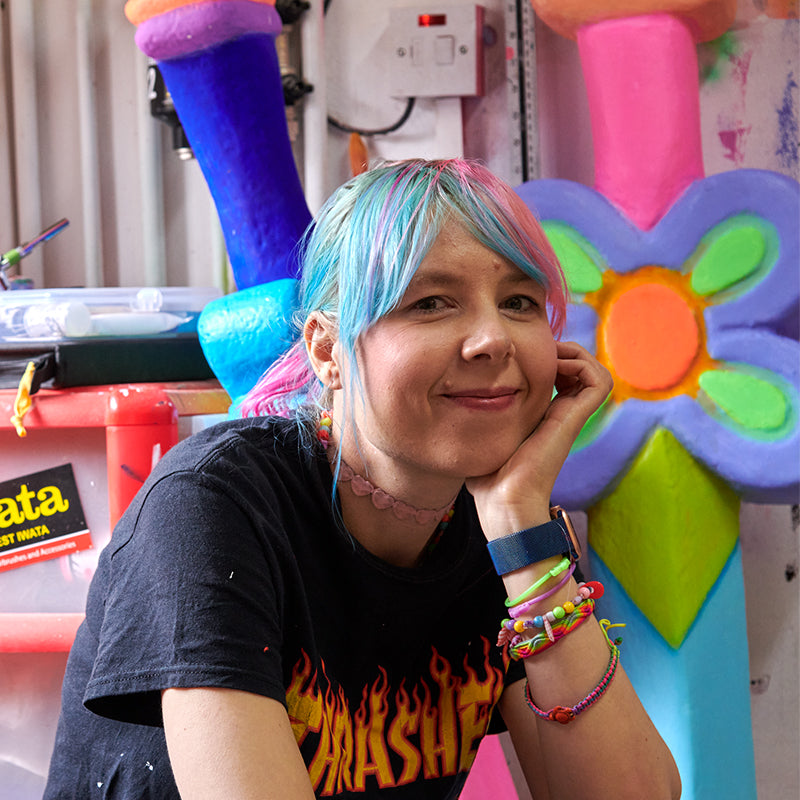


Beth McAlester is a Northern Irish artist based in London, England, exploring themes of identity, commemoration, and place. Through her paintings on wood, she examines semi-biographical narratives grounded by post-Troubles contexts within the UK and Ireland.
Your work engages with identity and commemoration in a post-Troubles context, how does your Northern Irish background shape the narratives you explore?
I grew up in a mixed household with a Catholic Mum and a Protestant Dad and I feel a particular closeness to the grey area that is the peace process. Northern Ireland remains deeply fragmented as each person looks back on history with an independent, often unspoken point of view, dragging that baggage into a turbulent present. That isn’t unique to one place, but I've found that my background has given me a distinct vantage point from which to explore ideas of cultural dissonance. The process of making a painting demands mediation and understanding, and my aim is to change the present by reappropriating the materials of my past. As I move from a work’s inception to its completion, my outlook often shifts, as I depict scenes or figures who may belong to the ‘other side’ of a bygone conflict. Those narratives act as charged sites of composition and, therefore, of potential critical intervention.

Has relocating to London influenced your sense of self or place, is this a tension which appears in your paintings?
Painting in London definitely comes with its own preconceptions and implications, but I don’t think I would be able to create the way I do within an Irish setting. Here, my work is often presented without historical context, the need for one homogenising narrative or pressure for resolution. I’m free to explore ambiguity, contradiction, and the unresolved. Working here has also made me more aware of my own position and biases, as I have to consider my subjects through a broader external lens. By extracting these elements from their original context and resituating them in an art setting, I discover a new way of viewing them. In doing so, I am confronted with a new tension of place and perspective. This often comes with an impulse to play the role of a model citizen or objective observer, so that I may better ‘inform’ others or present some definitive moral truth, however I always try to resist that urge. It's a tension which is not always explicit in my paintings but certainly informs the way I approach my current practice.
Your practice blends autobiographical with historical and political themes, how do you navigate the balance between them?
As I navigate through different social structures, I try to look through others’ eyes to capture the texture of an experience in tandem with my own. There are multiple contradicting truths at play, alongside my own history and biases, which render a single ‘objective’ approach disingenuous and I’ve grown increasingly wary of making didactic work. That process assumes a false neutrality, as if we can stand outside of historical or political events. Rather I use lived experiences as a catalyst to engage with more universal collective experiences. By grounding broader themes in biographical, emotional narratives, I hope to create something that feels intimate but also clearly represents how conflict and its legacies filter into everyday life, sometimes quietly and insidiously. In my palette paintings for example, these intricate manmade structures, which each person may encounter differently, become a mode through which we may question how local authorities shape, disrupt and often exploit lower socio-economic communities.

Lot 54. Beth McAlester - Untitled
Negative Space is a recurrent motif in your drawings. Is this an intentional gesture?
I approach drawing as a more immediate form of image making that I can employ when I have a concept I want to feel out or get to grips with. There’s a fleetingness in it that encourages me to consider the space between things, in my practice and in life. Memory and ideas of truth are something I labour over a lot in my work and sometimes it helps to subtract elements entirely and embrace quiet ambiguity as the focal point of a piece. The materiality of charcoal on linen echoes that, and the space between marks serves as an activator, as absence becomes as crucial as presence. Negative space, for me, is a way of acknowledging uncertainty and that which resists being fixed.
In critiquing dominant narratives, are there any specific cultural assumptions or inherited biases you aim to reframe in your work?
I make a concerted effort to avoid the sensationalised images that became so synonymous with Northern Ireland in the latter half of the twentieth century. Reconciliation is rarely neat and understanding is hard won; painting allows me to trace these tensions quietly and materially, paying attention to the complex structures that lead to people harbouring certain positions. In areas that have not yet inherited the politics of reconciliation, the commemorations that I refer to serve as outlets for frustration as communities feel forgotten by the powers that be. Rather than destructive symbols, for many, a bonfire or mural stands as a beacon of community. Extremist behaviour is frequently a defensive strategy and I’d like a viewer to question how we arrived at this dynamic. That being said, my depictions are inevitably shaped by a perspective very different from those who participate in unionist festivities, but engaging with these belief systems and the structures that encourage them is crucial, not so that we can excuse them, but to understand them.
Do you have any projects on the horizon that you would like to share?
I don’t have any specific projects to share just yet, as I’m turning my focus fully toward my postgraduate studies at the Royal Academy Schools. I am in a position where I can completely immerse myself in the studio and want to take full advantage of that opportunity; experimenting, reflecting, and discovering how the histories and tensions that interest me continue to shape the work to come.
Visit Beth McAlester's Website
Questions by Victoria Lucas


