
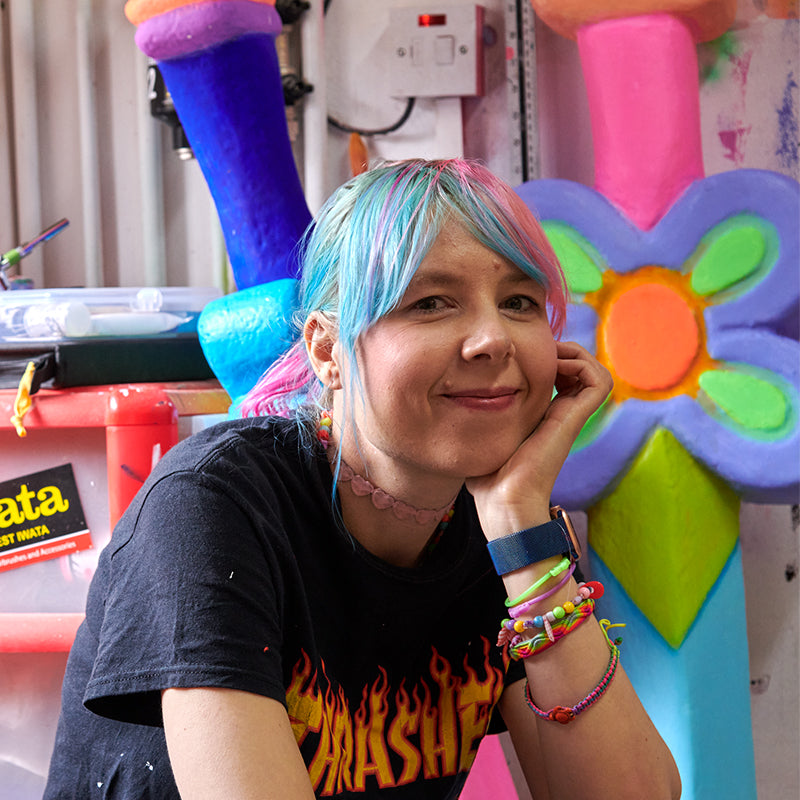


Kate McCrickard is a British painter living in Paris, France. She studied Fine art at the University of Edinburgh, Scotland, obtaining first class honours in the double discipline of History of Art and Painting. Painting, drawing and printmaking are at the heart of her practice. Kate’s works belong to the collections of the British Museum; De Reede Museum, Antwerp; LACMA; New York Public Library; The Metropolitan Museum of Art; Pallant House Gallery; Royal Scottish Academy and Weslyean University Davison Collection.
How do memory and imagination interact in your work? Are your compositions from recollections of real places, or inventions that emerge intuitively through painting?
Bonnard’s transition towards working from memory and imagination rather than observation – and also his dictum not to paint from life, but to put life in the paint – are instrumental to me. My work is a mess of both: the settings are drawn from recollections, but become inventions through painting itself, and whimsical colour choices. So the local bar, the studio and now I’m trying to remember northern landscape, are some of the ‘settings’. Some details are real, but if you can free yourself from direct observation, you walk out onto a vast new landscape. I never want to be prescriptive and tell people what they already know, so I hope to fall into that wide gap between the real and the imagined.
The real discovery does come in the making, though, and most of the work is entirely intuitive. It sometimes takes months before I can look back and ‘see’ what I’ve done, with little idea how it really came about. There is rarely a plan, and I do grapple with paint in order to ‘find’ the image. Layers of pentimenti occasionally ‘give up’ a face or a form; those are good moments, like excavating treasure.

Kate McCrickard, Rotten Island, 2025, Oil on linen, 98 x 160cm.
There is often a tension between humour and darkness in your work. Is that contrast something you consciously explore?
The two surely work together? I’m learning to play with painting’s endless possibilities and that encompasses visual wit and insider games. Conscious explorations rarely work for me apart from in printmaking, but neither is painting, for me, about stream of consciousness. I’d like to make more violent images, but I can’t keep the humour out, and the sensuous nature of oil paint, by its nature, can soften. I’m often asked why I paint ‘death’, but my initial use of the skeleton simply came from my inability to paint a head. It was a substitution, and a form that is fun to paint. I don’t think of them as ‘dead’; they’re often very busy. Terrifying historical images of Death snatching babies and such, in times of pestilence, are grim and true, but the artist’s glee is also apparent. Everyone loves looking at a mouth of hell.
It’s quite a ludicrous thing to be alone with paint all day and I think one thing that British painters do have is irreverence. I don’t like pompous painting and that’s what would happen if I try to go ’dark’. Madness is one response to horror, which is why I started making images of lunatics – when it sunk in that the West was going to do absolutely nothing to stop genocide in Gaza.
You often mix the ordinary and the surreal, creating scenes that feel both familiar and dreamlike. What draws you to this collision between everyday life and the fantastical?
This comes partially from the dilemma of whether to paint from life or not. I’m too self-conscious to ask people to sit for me for long periods, and I’m not made for social realism or a logical palette. But I’m not interested in magical realism or pure fantasy either, so I’m left with dredging imagery out of memory and imagination and walking that tightrope between conjuring something dreamt up and including living touchstones to anchor it back down. I’m looking for forms with event, rather than imposing a narrative.
Saying that, most figures in my work have been ‘seen’ or observed in some manner, and sketched. This is very helpful if I can’t find anything in the paint. It’s a slippage between the observed into the type – these are inventions that are also real.
The motif of the table features often in your pieces, as a place of gathering, excess, or conversation. What draws you to the table as a centre-point?
The table came from hours sat feeding my toddlers and exploiting them for use in paintings. Living in France, there’s a lot of emphasis on good eating, long meals and a lot of talk about food. I have the outsider’s advantage where I can take a table scene – so loved in Bonnard’s work, or the bar, so loved in Lautrec of Degas – and get away with it with less anxiety of influence. It’s just another stage with great potential for bad behaviour between protagonists, and a setting for mixing in still lives. I like it tipped up onto the vertical.

Lot 20. Kate McCrickard - Lunatic
The theme for this year’s Sound and Vision centres on the lyric “If I only could, I’d make a deal with God.” Were you directly influenced by the lyric, or did you approach it from a more personal or alternative perspective?
I’d already stolen from Kate Bush’s Hounds of Love for imagery in earlier paintings, so it was a real pleasure to take another lyric from that album as a prompt. I was painting nutcases in my despair over Gaza, but my Warchild lunatic is the innocent whose ‘deal with god’ is his insanity: ‘Blessed are the cracked, for they shall let in the light,’ said Groucho Marks. He is the foil for the sadistic lunatics – the male ones who are destroying our planet, making their deal with the devil.
Do you have any projects on the horizon that you would like to share?
I’m in a two person show with my dear friend, the fabulous Russian artist, Dasha Shishkin, opening Nov 13th at Emanuel von Baeyer here in London. And I have the honour of sharing the walls with Paula Rego’s Prince Pig lithographs for FOLIA at De Queeste Fine Art in Belgium, opening November 2nd.
Visit Kate's Website
Questions by Victoria Lucas


