
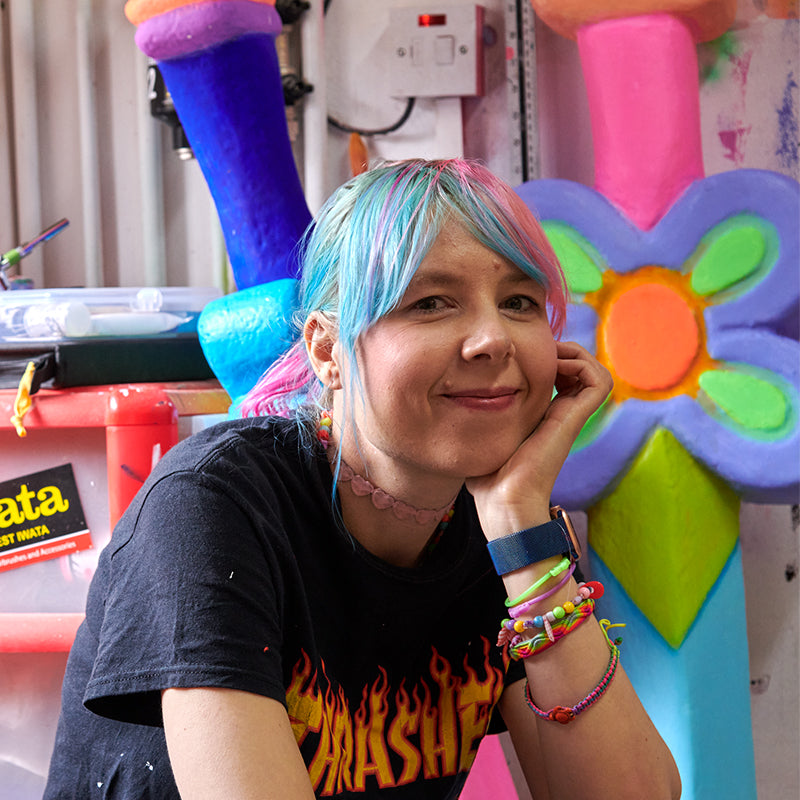


Ruth Heaton explores painting as an expanded practice which is informed by architectural structures, interior design, and objects drawn from domestic, decorative, and popular culture. Geometry, symmetry, spatiality, and process based approaches are consistent areas of interest in the application of her practice. She is the curator and programme lead for a local community gallery in Huddersfield and also provides curatorial and installation assistance to an artist led gallery in Sheffield.
What continues to draw you to the formal structures of geometry, rhythm, and spatiality?
My interest in architecture and the built environment, both classical and contemporary, has been a significant influence on my practice in terms of composition and to some extent material choice. Equally interior design ideas from wallpaper and furniture to glassware and china are consistent sources of inspiration. This interest grew from early childhood visits to stately homes where I became fascinated with the grandeur of buildings, formal gardens, and decorative interiors. Geometry, rhythm, and spatiality are a number of considerations I work with when I am designing my response to this. I am not interested in flat structures, I like the rhythm that is created by the repetition and symmetry of the line, this enables me to create movement. My colour palette is used to develop the depth of the form and create a sense of space within the work. I work from site visits, my own photographs, and other reference material, abstracting a specific aspect of the design to develop my own interpretation of the experience whilst also creating a new design. I am less interested in a factual interpretation or reproduction of things, so in many ways focussing on a specific aspect I am drawn to and engaging with this captures the essence of the design.

Lot 253. Ruth Heaton - Connect (Left)
Lot 254. Ruth Heaton - Fade (Right)
How does your expanded approach take shape across different media, spatial installations, or modes of audience engagement?
I describe my practice as expanded painting as I use paint on a variety of substrates whether this be wall, floor or plinth based. This also reflects my interest in architectural structures, and modes of design and spatiality. I rarely paint on canvas or paper and prefer to use materials such as wood, MDF, metal, and concrete. I generally work in a series and this can take the form of wall based paintings or I expand the design onto more sculptural pieces that sit beyond the wall and enter the space of the room. I sometimes incorporate building materials such as metal and concrete into my wall based paintings to enhance the visual experience of the design. I am always conscious of building or creating something within a space and I have in the past created more immersive installations. I will often reconfigure my work when exhibiting in different settings, sometimes adding new pieces, as I am interested in how this develops an idea and creates a new experience within a given space.
In your works inspired by Gothic architecture are you responding to specific historical sites, or are you engaging with the broader themes and atmospheres of the Gothic?
The Gothic series was part of a project I was developing, which is still ongoing, referencing Cathedral architecture in the North of England. I wanted to create work which captured some of the palpable weight of history you experience when inside these enduring structures, with the spires and towers often seen from afar amongst a variety of different building structures that have developed around them over the years. The Gothic series was developed compositionally from the classical pointed arches of the windows. I wanted to design something that captured the ornately carved work whilst also getting a sense of the romanticism and dark medieval associations of the period. Colour palette and symmetry were key elements of the design. I did not initially set out to explore the broader themes of the Gothic but for me it is inevitable that this will permeate the work as I am not just exploring the technical aspects of the architecture but the feeling it invokes when you engage with it.

You have been active as both artist and curator. How does curating others’ work influence your own studio practice?
I see curation as a part of my creative practice and when I am developing work I always have one eye on how it might sit within a given space. It is also useful for me to have a transitional approach to my work in that I will vary how it is curated in response to the environment it will sit in. This enables and inspires me to see the work differently and also to lean into new work and ideas. Equally I am also informed in much the same way by how others curate my work, it is always an opportunity to learn when you give others the freedom to reinterpret your work, as it is for me when I curate other artists work. Curating others’ work enables me to play with the architectonics of the space and again this becomes part of my own learning cycle particularly in relation to composition and design.
In what ways has your background in mental health nursing and academia shaped your practice?
When I worked as a lecturer at the University of Salford I led a project where I incorporated mental health nursing practice and academic research with a group of third year nursing students. Combining theory and practice I led lectures and workshops on how participatory art can contribute to aiding recovery in mental health practice. Students attended theory lectures but also participated in creative workshops I facilitated, where they were encouraged to make a piece of artwork. At the end of the 18 month period I curated an exhibition of their work, which also included work I had made in response to their work. The purpose behind my approach was the assumption that the best way to see the benefits of creative practice for others was to engage in creative practice yourself. Equally working in an academic and clinical post has always made me value the principles of research based practice and this is something I continue to incorporate into my creative practice. I am a process based artist and I enjoy both the intellectual and poetic aspects of making, in the sense that the technical building blocks create or lead into an aesthetic moment.
On a personal level I am aware of the emotional attachments and memories of experience from childhood and the colours and forms that over time find there way into some of my designs. Through my mental health practice time I recognise the significance and power of how attachments inform our intellectual, and creative processes. The connections may not be obvious to the viewer but I like the quiet power of their presence in my work.
Lot 255. Ruth Heaton - Unravel
Do you have any projects on the horizon that you would like to share?
I am leading on 2 group exhibitions that I will be curating in Sheffield this October and Redcar in May 26. In my practice I am currently working on a domestic still life installation using cast concrete and paint, and I am continuing to develop my Cathedral series.
Visit Ruth Heaton's Website
Questions by Victoria Lucas


