
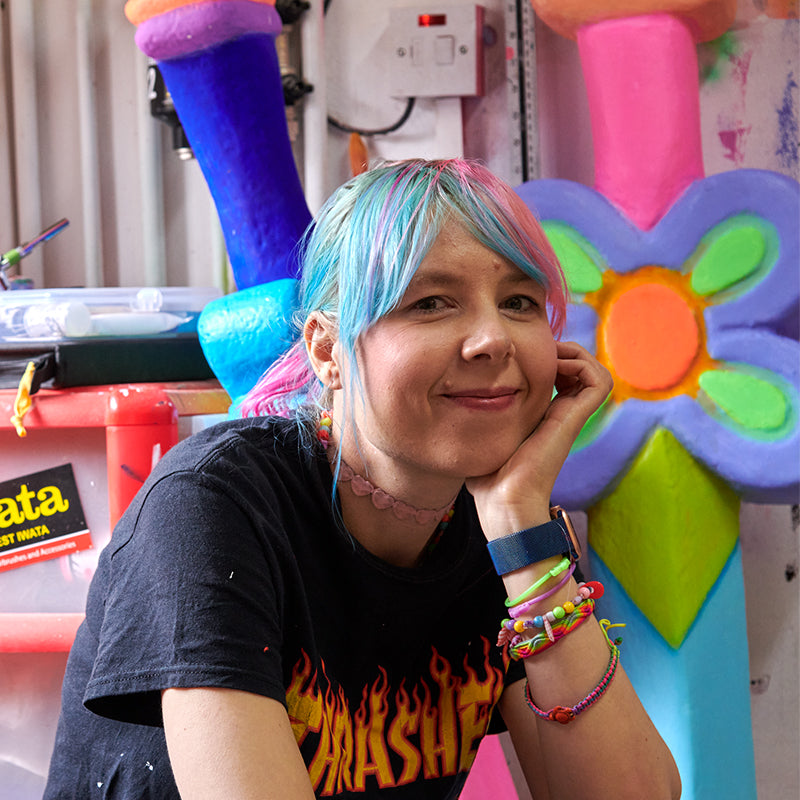


Tabish Khan is an art critic, writer, speaker, podcaster, and curator who passionately believes in making art accessible to everyone. He visits and writes about hundreds of exhibitions a year, covering everything from the major blockbusters to the emerging art scene in London and beyond. He writes regularly for Londonist and FAD and has written for Artsy, Elephant, Stir World, and the New York Observer.
He is co-host of the podcast The Good, The Bad and The Arty and has judged many prizes. Tabish is a trustee of the prestigious City & Guilds London Art School and Discerning Eye, which hosts an annual exhibition featuring hundreds of works. He is also an honorary trustee of ArtCan, a non-profit arts organisation supporting artists through profile-raising activities and exhibitions. He is also a critical friend of UP projects that brings contemporary art to public spaces.
Why did you want to guest curate for Art on a Postcard?
It's an excellent opportunity to showcase the work of artists whose work I believe in, and it's a chance for more people to see their work. I'm a proponent of making art accessible to everyone, and this is another chance to make the works of great artists visible and purchasable to the public. I've been writing for nearly 15 years, but I'm still new to curating, so it's a great chance to flex some curatorial muscles. I'll let others decide whether I'm any good at it.
Art on a Postcard plays a key role in raising funds and awareness for The Hepatitis C Trust. What makes you want to help fundraise for the charity?
I've always admired the work of Art on a Postcard and the large sums it's raised for an important cause. When it comes to helping important causes, the arts sector always steps up and does a great job. I'm on the board of multiple charities, and if I can spare the time to support any worthy cause, then I'll try my best to do so.
What were the key things you were looking for when selecting your artists for this auction?
I wanted to include a mix of artists, emerging and established. I'm always keen to promote artists who are not getting enough attention, and there are some of those in my selection. I also chose artists who could make impressive works at a postcard-sized scale.
Do you think it is a challenge for artists taking part to work on such a small medium?
Some of these artists have worked at a small scale, others haven't. So I imagine it was more challenging for some, but many artists I know love a challenge and rise to meet it. I love how different artists approach the limitation; some scale their works down while others take their work in a new direction to meet the size restriction.
What do you hope people take away from the Summer Auction?
I hope they discover new artists, feel emboldened to bid on them and buy a work to take home. Knowing that in doing so, they are supporting a great cause.
Do you think this auction format supports/impacts emerging artists?
It’s a chance for the works of emerging artists to rub shoulders with those of their more established peers, and potentially meet them at the opening. Plus, having different curators encourages them to put forward the artists they want to champion. It ensures there’s diversity in artist styles and backgrounds.
What advice would you give to someone buying their first piece of art?
Start small, set yourself a budget and buy what you love. Whether an artwork you buy goes up or down in value doesn’t matter, as you remember why you loved and bought it in the first place. A lot of people dither on their first purchase, so always start with something more affordable, as the psychological and financial barriers are lower.
How does a small-scale format like this appeal to new collectors?
It’s much more affordable and lets you purchase lots of works by different artists, rather than going for a single large-scale artwork. I own over 400 works, hung in a two-bedroom flat, and most of them are small in scale, so future purchases now have to be small due to my limited wall space. You can always find space on your wall for something small-scale.
Do you think there is a shift in how people are choosing to build their collections?
I don’t know, but I’d encourage everyone to know they can be an art collector. People often think of billionaires as the only art collectors, and they make all the headlines, but anyone can be a collector. Go to exhibitions, meet lots of interesting artists and go from there. That’s how all art collections should be built.


