
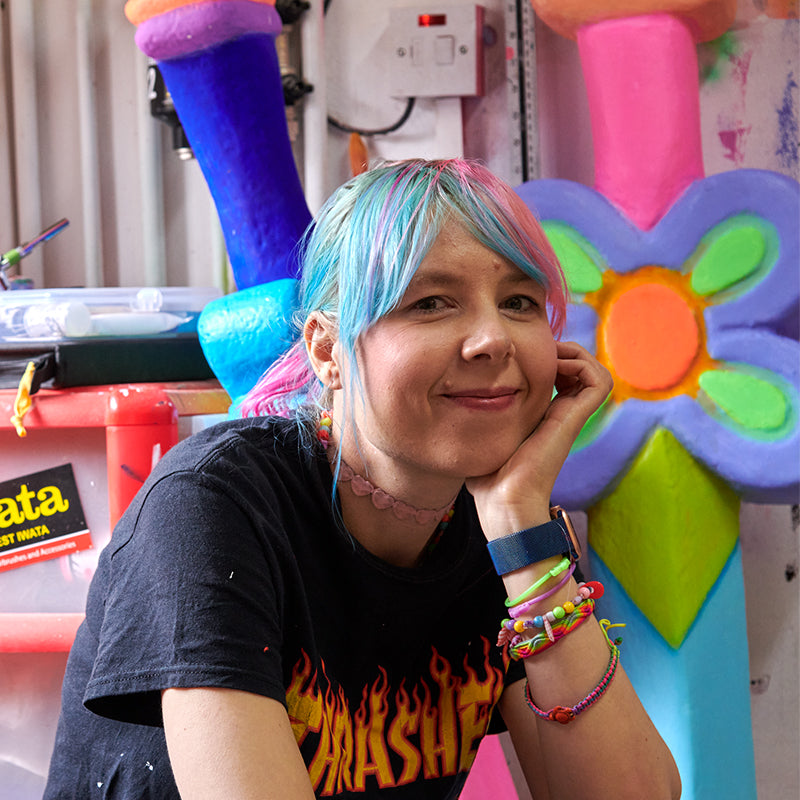


Lauren Estelle Jones is the co-founder of the contemporary art organisations Art Barter and Alteria Art and acts as an independent curator, consultant, and advisor. She works internationally to initiate projects featuring emerging and established contemporary artists across creative disciplines, with a focus on visual art and music. Jones has worked closely with over 800 artists throughout her career and has selected 53 to participate in this auction, ensuring that there is a mix of established names alongside emerging talent, as is typical of her practice that aims to democratise the way that people experience art.
Why did you want to guest curate for Art on a Postcard?
I have been following AOAP’s journey since the inception 11 years ago and have always been impressed by the quality of work, the range of artists and the innovative exhibitions and events that they have put on. I met the founder Gemma last year and quickly realised that the project’s success is a product of her tireless dedication and forceful determination and it was a complete honour to be asked to guest curate. It gave me a reason to reconnect with artists that I hadn’t been in touch with for a while and was a way to give a platform to some new acquaintances – all whilst raising funds and awareness for the important work of The Hepatitis C Trust.
Art on a Postcard plays a key role in raising funds and awareness for The Hepatitis C Trust. What makes you want to help fundraise for the charity?
Through working on this project I have learnt more about the vital work that the Trust carries out and I would like to draw attention to this as much as possible. As Gemma pointed out, it may not be the “trendy” charity, but the work is absolutely as important. I was aware of their goal to eradicate Hepatitis C in the UK but I learnt so much more about their wider work which delivers frontline support to some of the most marginalised communities, including vital peer-led programmes in women’s prisons, where they provide education, testing, and treatment access for those who are often overlooked by the healthcare system.
What were the key things you were looking for when selecting your artists for this auction?
I have been working with artists for over 20 years and have curated numerous large group shows which can be challenging as you must ensure that every artist is being given the space and environment that their work requires and deserves – however - this format automatically dedicates the same space to every artist and so it was quite freeing in that respect. It is always important to me to include a mixture of established artists alongside emerging talent as it offers visibility and a platform to those at the start of their careers. This ideology feeds back into questioning the concept of value and engaging viewers into being active participants which is in alignment with my practice and the principles of AOAP. For this auction, the format of the postcard could have been limiting but I was keen to invite ceramicists, textile artists and sculptors and I was really excited to see how they responded to the brief.
Do you think it is a challenge for artists taking part to work on such a small medium?
I think it is a wonderful opportunity for artists to think outside of their usual practice. I curated an exhibition called ‘Through The Looking Glass’ at Cob Gallery some years ago where we asked artists to make their usual work but on a much smaller scale and had a really positive response. The restrictions of the work also being “a postcard” – I think gives an extra challenge and point of interest for the participating artists.
What do you hope people take away from your Auction?
My hope is that people will feel uplifted and joyful.
Do you think this auction format supports/impacts emerging artists?
Absolutely! Placing artworks by household names on an equal par with emerging artists gives them invaluable exposure and confidence.
What advice would you give to someone buying their first piece of art?
Go for the piece that you love and want to look at every day and if you can’t afford it - ask the gallery if they are willing to offer you a payment plan. My first art purchase was a framed Polaroid by Patti Smith from Trolley Gallery on Redchurch Street which sadly no longer exists. I was a recent graduate and they very kindly agreed to me paying for the work in instalments of £50 per month over a year. I still have the piece on my bedroom wall and it still makes me happy every time I look at it.
How does a small-scale format like this appeal to new collectors?
Small format often means that the starting price can remain low and the auctions are always filled with lots of new artists to discover. This, along with being able to view the works online without the pressures that can sometimes be associated with the gallery setting, gives new collectors an easy way in.
Do you think there is a shift in how people are choosing to build their collections?
I think there is a lot more awareness and desire to collect pieces that are created using sustainable materials and techniques which has given a revival of craft and analogue based practices which I personally am often drawn to.


