
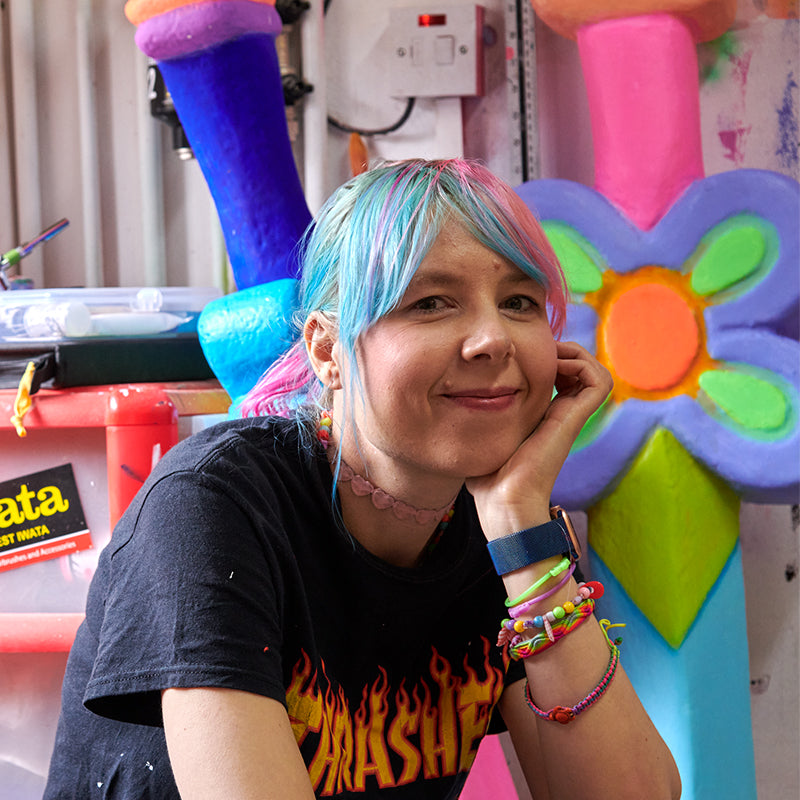


Charlie Calder-Potts is a British artist based in UK. Her work looks at history and its repetitive nature; the value of our heritage and our similarities to previous generations and to each other. Charlie has had many notable awards, exhibitions and commissions both in the UK and abroad. Previous projects include her selection as an Official War Artist with the British Army in Afghanistan 2013/14, private commissions in Iraq in 2015 and Tajikistan in 2016, a collaborative project sponsored by The British Arts Council in Iran, 2017/18 and Russia 2018/19. In May 2021 she was awarded the QEST scholarship (Queen Elizabeth Scholarship Trust) for her project in Pakistan and in March 2023 she was awarded the Daler-Rowney Prize by the Royal Watercolour Society, London. She received the Daiwa Foundation Award for her 2024 project in Japan ‘Offerings from Nara’ and at the beginning of this year her first wallpaper mural ‘Lost Lands’ was released in collaboration with Zoffany.
Your work explores history’s cyclical nature and the connection between past and present. How do you balance historical research with a more emotional, intuitive approach?
The start of a new project is always spent revisiting my favourite corners of The Bodleian and The British Library. In allowing myself these days and weeks focusing on historical research, reading around my initial idea, I am inevitably always drawn to a particular thread. As I pull at that thread I become more emotionally invested and consequently search out to gain a more visceral understanding. Learning a new skill and/or travelling to various sites and countries alongside an artist with a more personal/intimate understanding of a subject naturally helps in the marriage of the historical with the emotive.

Charlie Calder-Potts, At Home with Shintobe, Mixed Media on Antique Paper, 57 x 22 cm
You’ve followed the Silk Road through countries like Afghanistan, Iran, and Japan. How has that journey shaped your understanding of cultural exchange and art’s role in bridging different histories?
Travel has played a central role in shaping my practice, both technically and conceptually. Much of how I work today comes directly from time spent learning from artists and makers across the world. I’ve studied icon painting in the studio of a traditional Palekh painter in Russia, sumi ink making in Japan, Indian miniature painting in Pakistan and each has left its own mark on my work and reinforced the significance of these personal and cultural exchanges as a whole. My time studying with Heraa Khan in Lahore, for example, instilled in me the importance of a respectful, almost meditative approach to painting and the materials used to create work. I learnt to prioritise natural pigments and make my own handmade brushes from squirrel hair and pigeon feathers; forever shifting my approach to painting.
Undoubtedly, my prior projects have contributed to the evolution of my practice, with every one leaving its own unique mark. Working as an official war artist in Afghanistan, I became focused on documenting individuals, especially in the face of war’s tendency to anonymise. This was when photography became a core part of my process due to its ability to capture presence and detail. In Iran, I collaborated with poet Rosa Jamali on a British Arts Council project. That work made me think differently about storytelling—specifically, how image and text can reflect and build on each other. Following routes like the Silk Road has given me a broader perspective on how techniques, stories, and aesthetics move between cultures. It’s made clear to me that cultural exchange isn’t abstract—it happens through shared work, conversation, and learning directly from others. This is what will continue to shape my practice indefinitely.

You’ve described your series as ‘dissertations,’ collating research into visual essays. With a background in Art History rather than formal art training, how does that shape your practice?
I guess technically I could be described as an ‘untrained artist’ in that I have never been to art college but instead studied Art History and Theology at St Andrews University in Scotland and it is this background that I think in many ways forms the foundation of my practice. By saying my work is a series of ‘dissertations’ what I am trying to illustrate is that my approach to a new subject is in many ways the same approach I would have to writing an epically large essay! I broach a new subject by using the same formula; research followed by an argument followed by a conclusion. This structure helps me to condense my ideas into a cohesive body of work.
The theme for this year’s Sound and Vision centres on the lyric “If I only could, I’d make a deal with God.” Were you directly influenced by the lyric, or did you approach it from a more personal or alternative perspective?
I have been a Kate Bush fan for as long as I can remember so when this project came in I immediately knew I would have no problem in being directly inspired by such an impactful lyric. Both at University, and in the process of making my work, I have studied many religions and scriptures from an academic perspective and encountered God and Gods through a myriad of lenses. My piece for War Child ‘to your sister’s house’ takes its title from the Epic of Gilgamesh (the original flood story written approximately 700 years before the Old Testament). In my work the hand you can see coming from behind the cloud (an undeniably recognisable historical image in the representation of ‘God’) is actually the hand from the figure shown in the painting (taken from a different photograph). We are all a part of each other and humanity must work together. To look to a higher power to ‘solve’ the problems of the world will not, in my mind, result in peace (although I wish it could).

Lot 19. Charlie Calder-Potts - To Your Sister's House
Do you have any projects on the horizon that you would like to share?
I am at the beginning of a new series that will be exhibited in a solo exhibition at The Fosse Gallery in April 2027. The work will re-imagine the Tacuinum Sanitatis; 14th/15th century illuminated medical manuals based on the 11th-century medical treatise by Ibn Butlan of Baghdad. The parallels between these medieval medical journals with our understanding of ‘wellness’ today make them feel particularly relevant since they emphasise (alongside natural herbal remedies) the importance of exercise, rest and mental health. I again hope to acquire new technical skills that will allow me to create a series of work with a visual integrity that reflects, and is faithful to, it’s medieval source. This manuscript urges us to connect with ourselves as well as the landscape that surrounds us not only in it’s teaching but also in the materials used to create it; something I hope to emulate.
Visit Charlie's Website
Questions by Victoria Lucas


